Mandelbrot Set
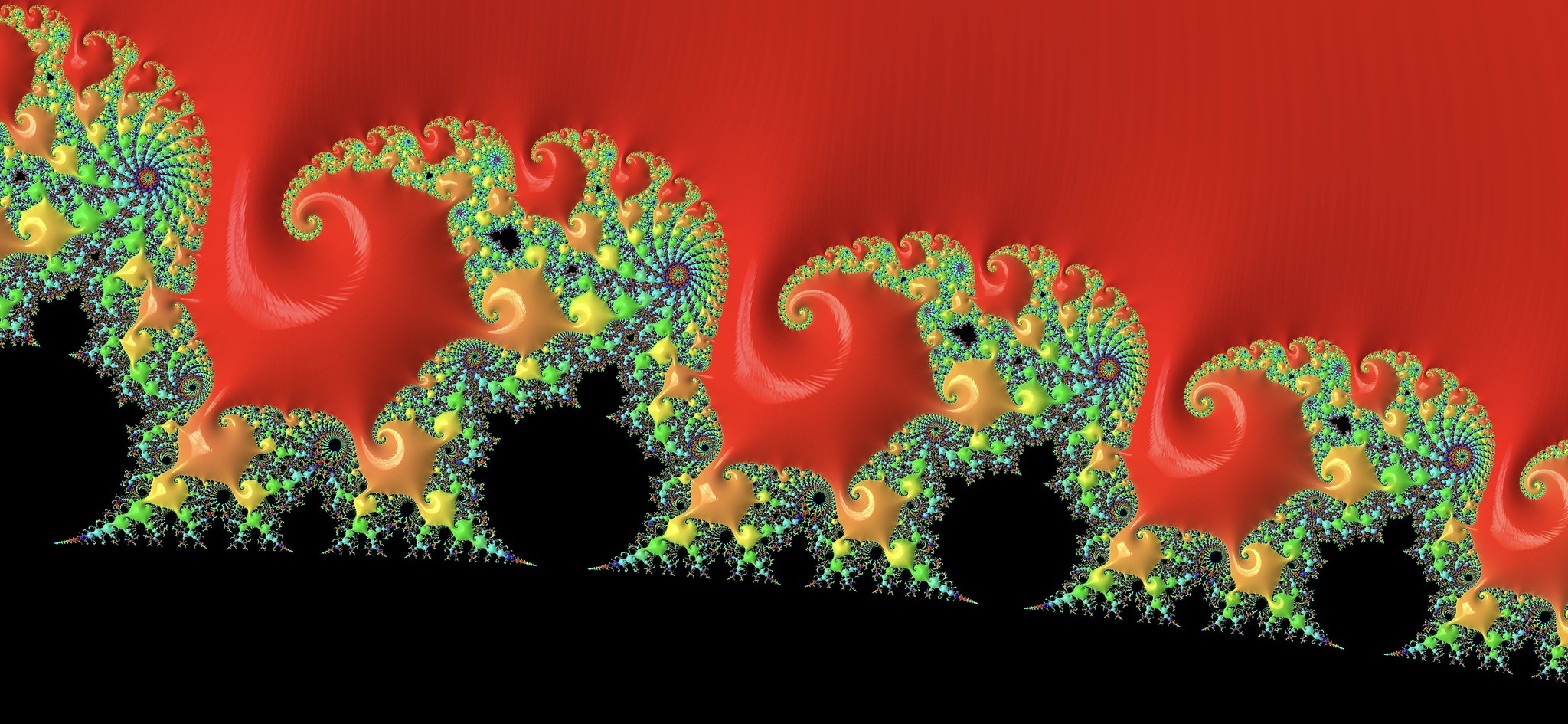
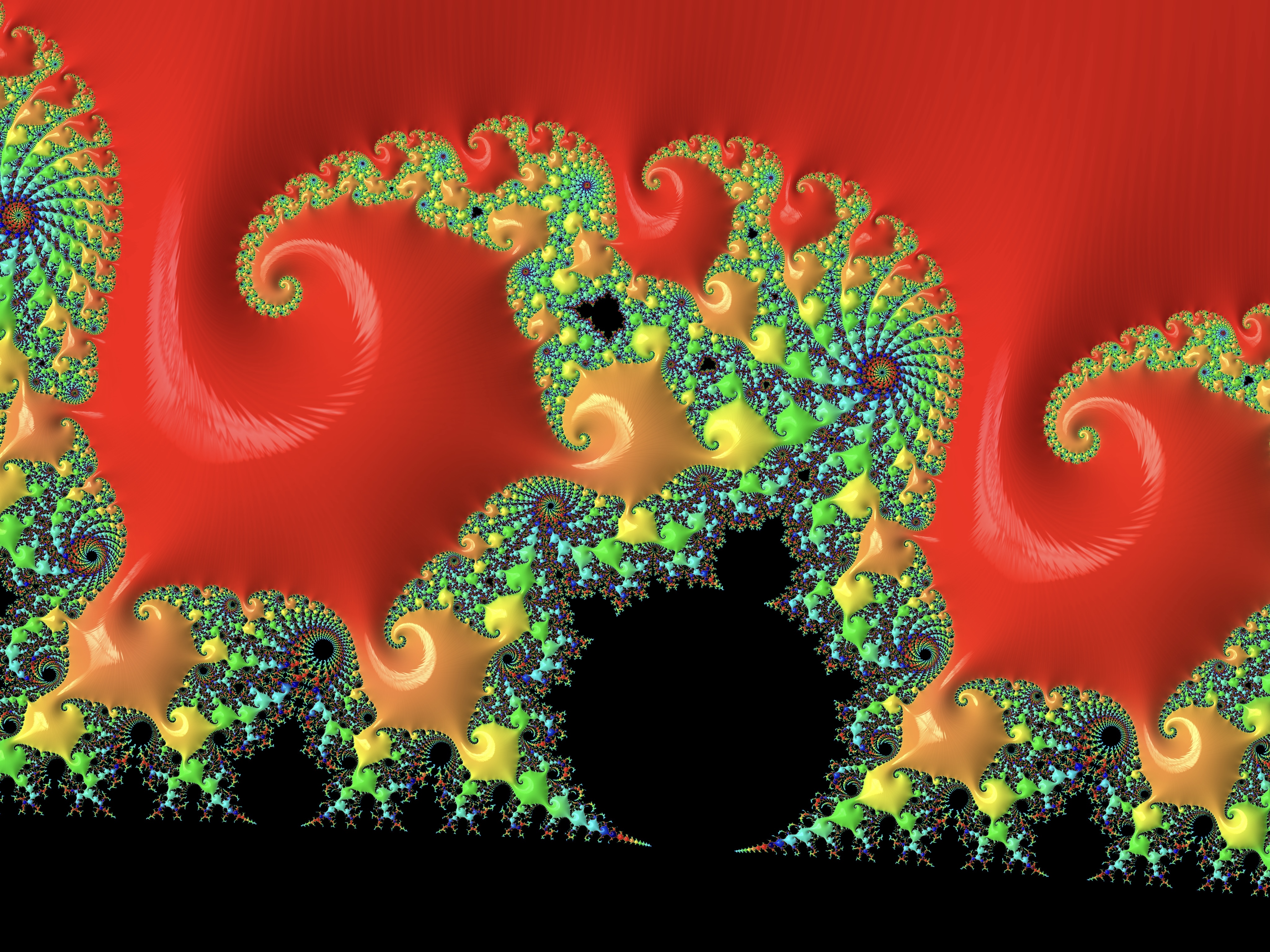
This mesmerizing fractal image, titled "Elephant Walk," emerges from the main cardioid of Mandelbrot set, showcasing a vibrant and intricate pattern. The dominant feature is a series of undulating, heart-shaped forms in a rich red, reminiscent of a line of elephants. These "elephants" appear to be walking slowly across the frame, their forms connected and extending into the distance.
Each "elephant" is adorned with a complex, spiraling structure that unfurls with an astonishing level of detail. Bright green and yellow hues dominate these intricate spirals, creating a vivid contrast against the red. Within these spirals, countless smaller, identical patterns can be discerned, a hallmark of fractal geometry. The bases of these forms is anchored by a black abyss, from which delicate, tree-like structures in shades of green and yellow sprout, adding to the organic feel of the image.
The visual rhythm suggests a journey, as if one is counting each stem from 1 to infinity, slowly traversing the boundless complexity of the fractal landscape. The overall impression is one of both meticulous order and infinite variation, a captivating glimpse into the mathematical beauty of the Mandelbrot set.
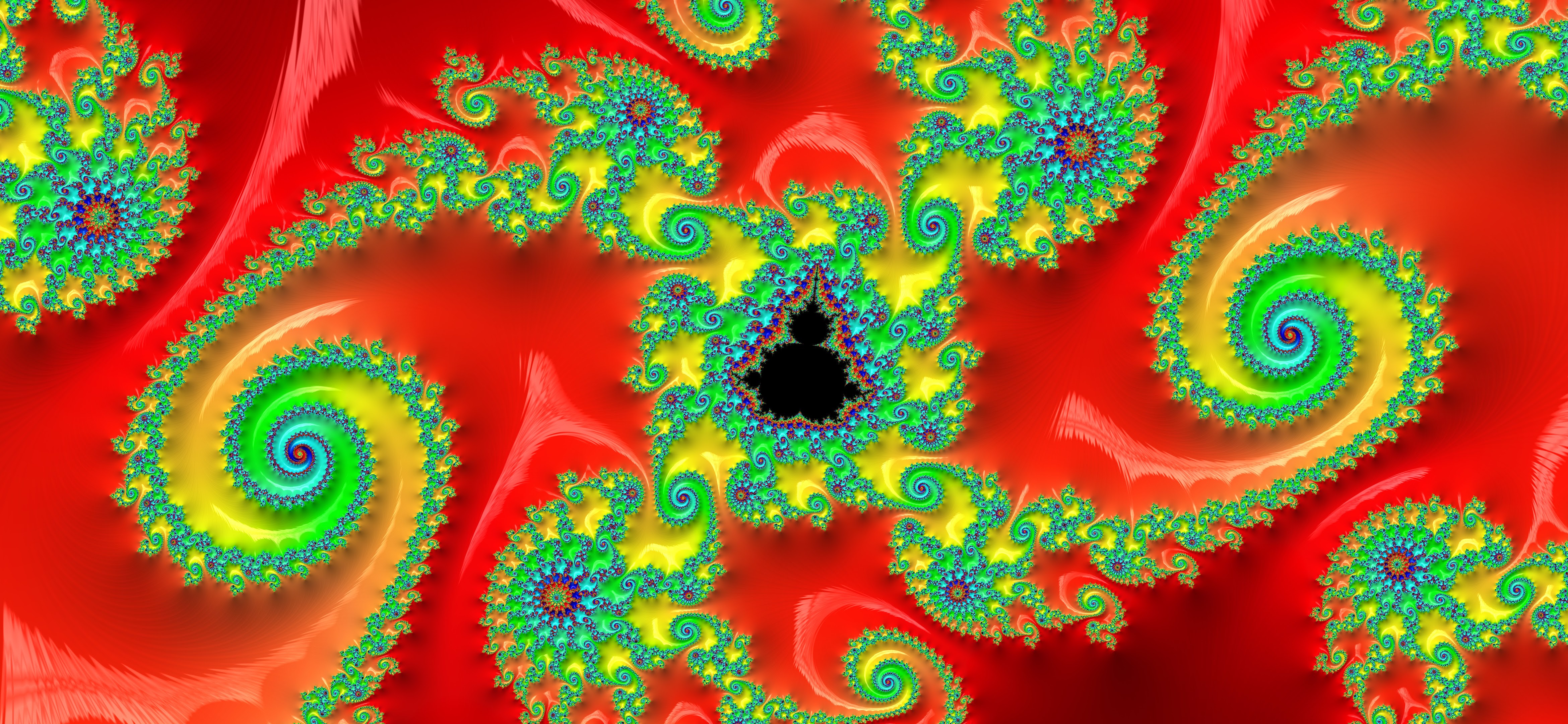
A vivid red field forms the canvas, broken by tight green-and-yellow spirals that coil inward like clusters of fern fronds. The contrast is deliberately loud — saturated reds against electric greens with veins of cyan and indigo — giving the piece a tropical, almost stained-glass intensity rather than the muted gradients more common in fractal art.
At the center sits the unmistakable Mandelbrot silhouette: the rounded cardioid joined to a smaller circular bulb, rendered in solid black. That black region is where the iterated complex sequence stays bounded; the colored bands radiating out from it map how quickly points just outside escape to infinity, with red marking the fastest escape and the green spirals tracing the slower, more tangled boundary.
The "recursive" in the title shows itself in the smaller Mandelbrot copies tucked inside several of the surrounding spirals — barely-visible black mini-bulbs nested at the center of each whorl. This self-similarity is the signature trick of the set: zoom in on any swirl and you'd find the same shape again, and again, all the way down.
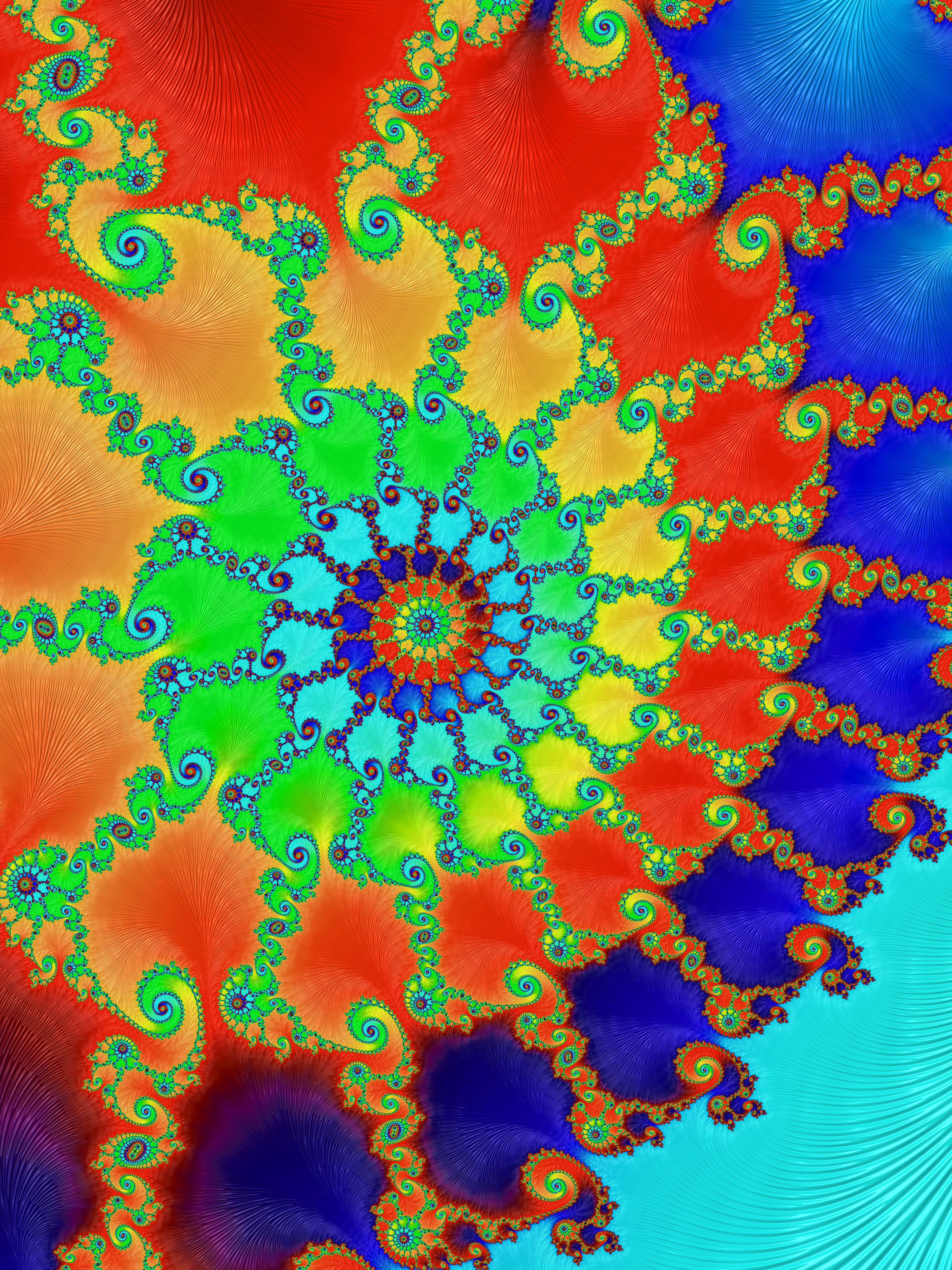
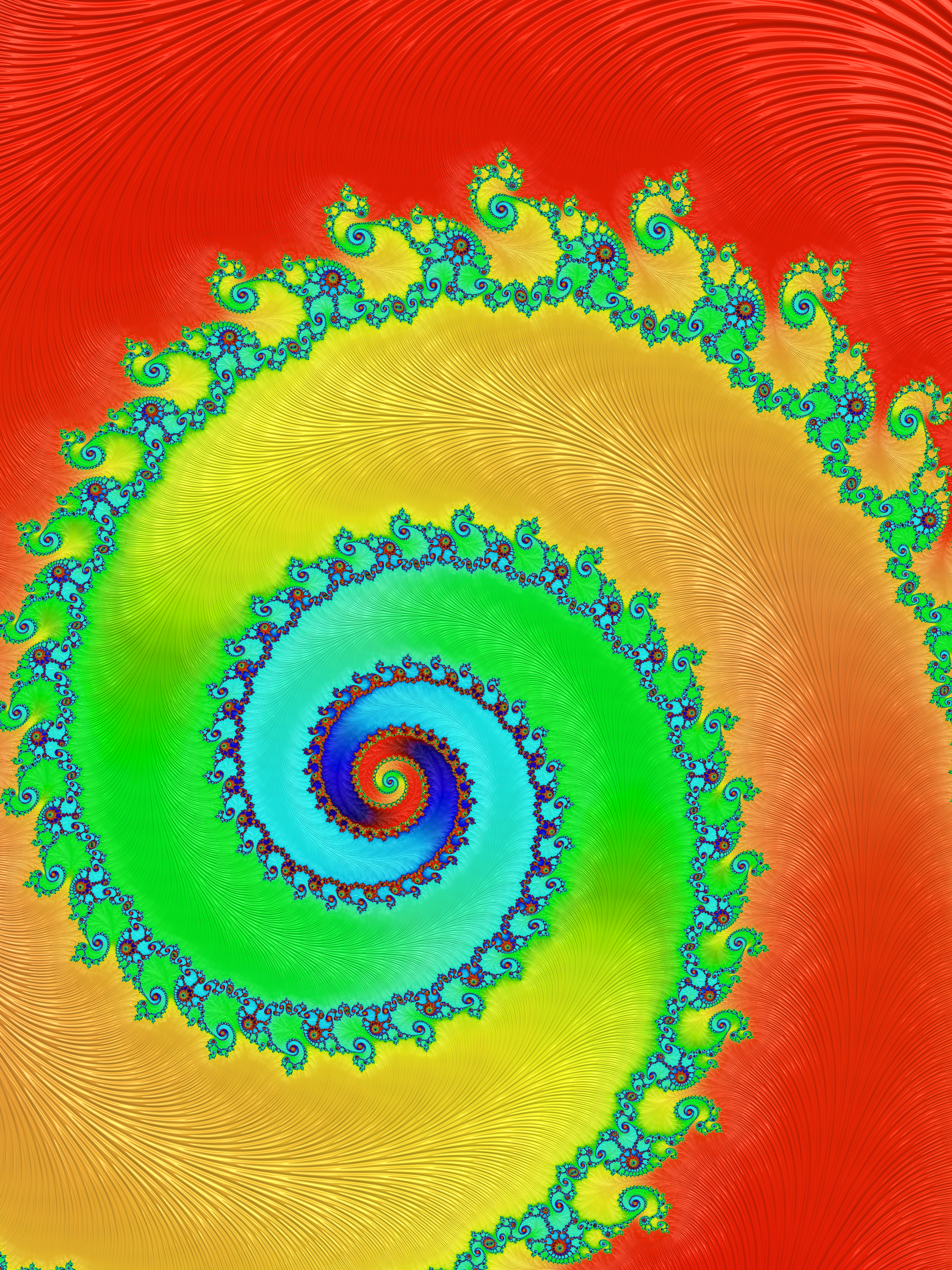
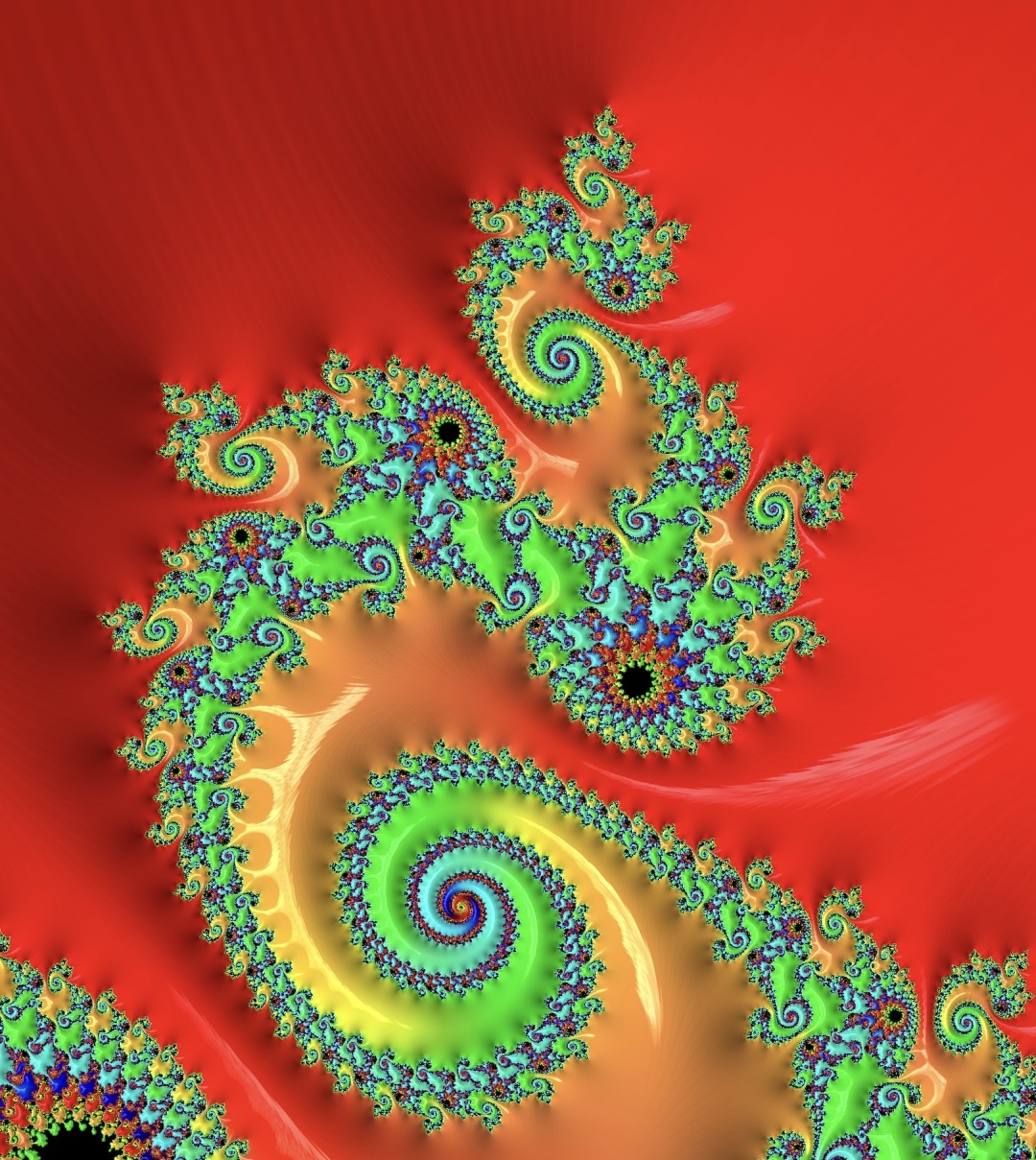
A single immense spiral fills the frame, sweeping from a fiery red outer rim through orange, yellow, lime, and green into a turquoise core that swallows the eye toward a tiny crimson-and-blue nucleus at dead center. The color progression is continuous rather than banded — the whole spectrum has been wrapped once around the spiral, so the eye gets pulled inward by both the geometric coil and the warm-to-cool drift of the palette.
The open color fields aren't flat. They're combed into fine radial striations — that smooth feathered texture is a giveaway for continuous (smooth) escape-time coloring, where instead of stepping between integer iteration counts the renderer interpolates them, producing those silken ribs that fan out from the core like brushed satin. It softens what would otherwise be hard concentric stripes into a single flowing gradient.
Riding the spiral's edge is the lacy fringe of green and cyan filigree, peppered with reddish-brown nuclei. Each of those nuclei is a miniature Mandelbrot bulb, spaced along the boundary like beads on a string — the signature of a deep zoom near a Misiurewicz point or parabolic neighborhood, where the set's structure repeats around a rotational center. The further in you go, the smaller and more numerous the beads become, and they'd keep going indefinitely if the render had pushed deeper.
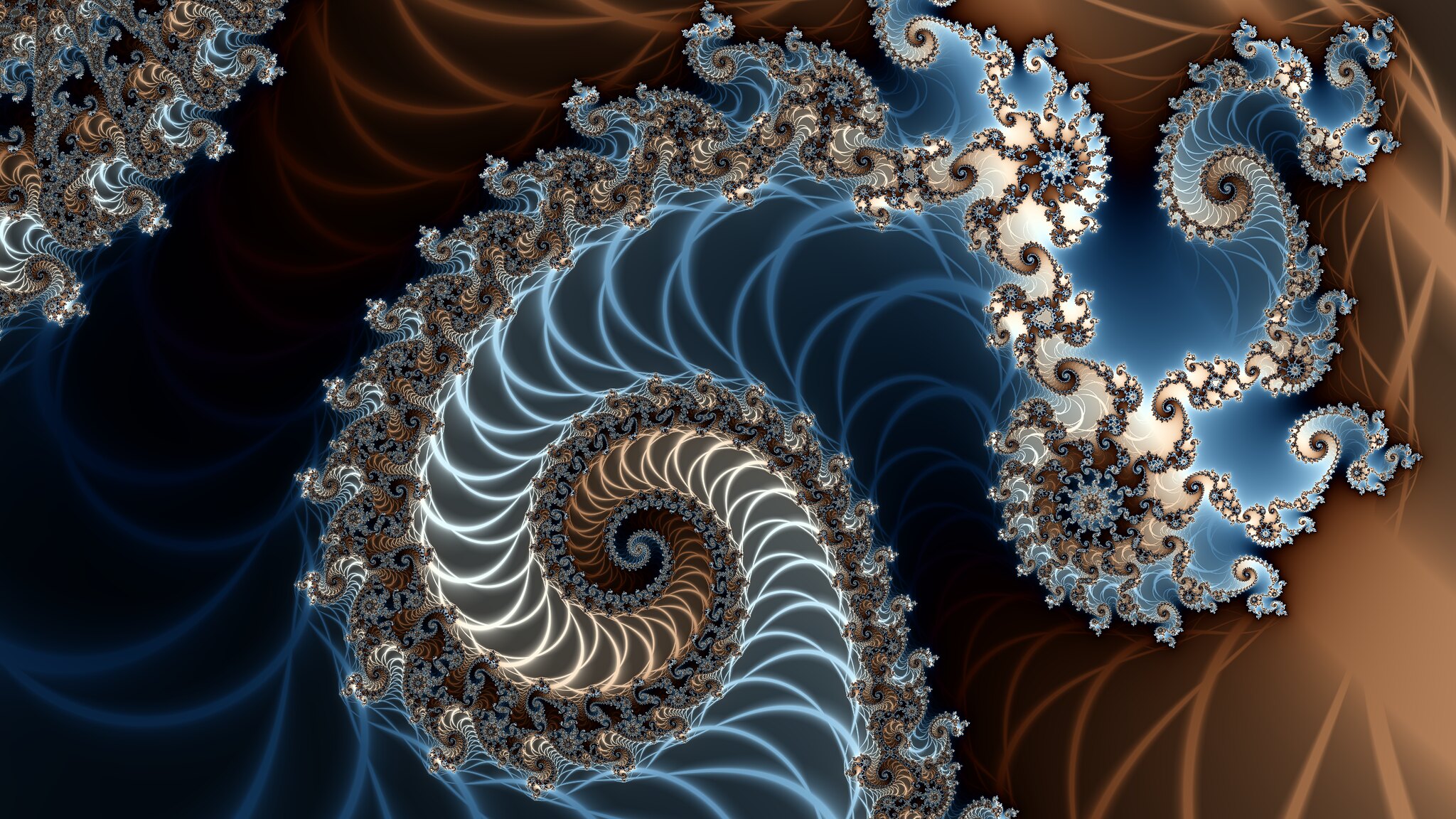
The composition is dominated by a single great logarithmic spiral coiling inward in the lower left, set against a deep navy-to-sepia background. The palette is more restrained than the Mandelbrot piece — cool slate blues, cream, and warm umber browns — giving the image the feel of an antique etching or the inside of a polished nautilus shell rather than something overtly digital.
The "orbit trap lines" of the title are doing most of the visual work here. Instead of coloring each pixel by how fast its orbit escapes, this rendering measures how close each iterated point passes to a set of geometric lines, then colors it accordingly. That's what produces the long, swept fan blades of cream light fanning out along the spiral and the silvery filaments threading through the brown lacework — a softer, more painterly look than the banded escape-time gradients.
The detail along the spiral's edge is where the recursive structure really earns the "dragon" name: a chain of armored, vertebra-like scales, each one a tiny version of the larger whorl. Look at the corners and you'll see the same form repeating at different scales — smaller spirals tucked into the upper right and middle right — confirming this is a deep zoom into a self-similar region of the parameter plane, with each fractal generation echoing the one above it.
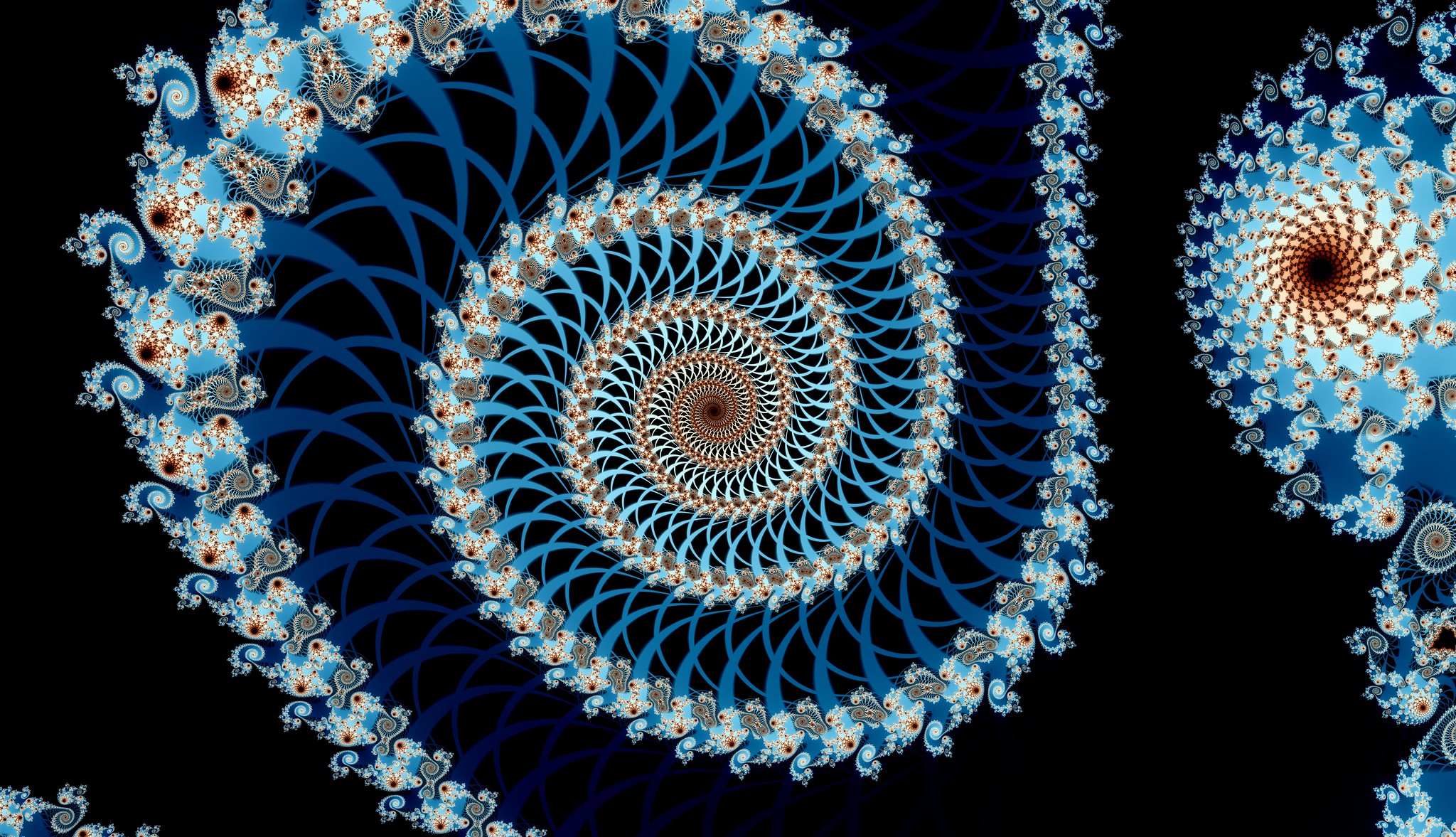
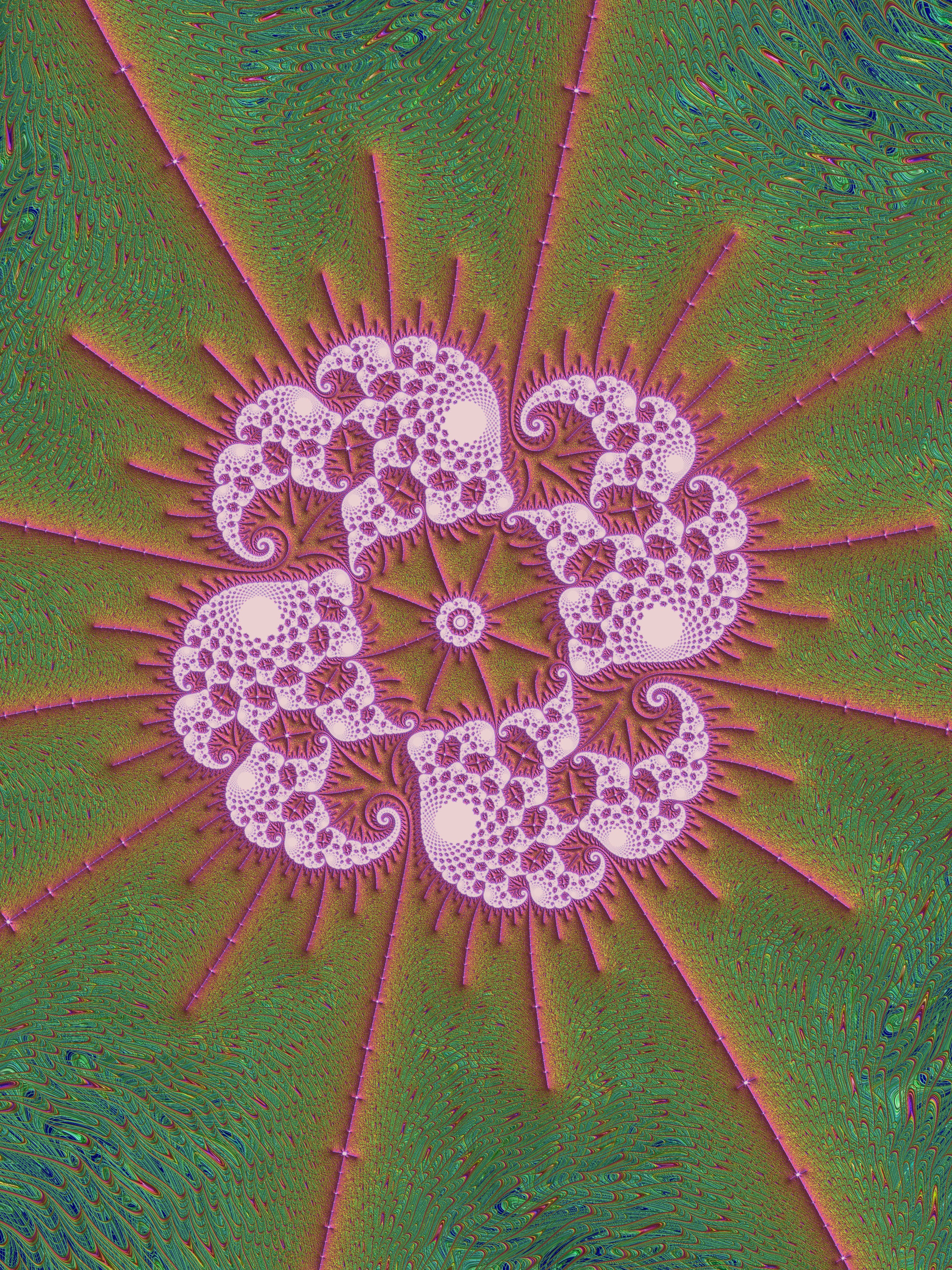
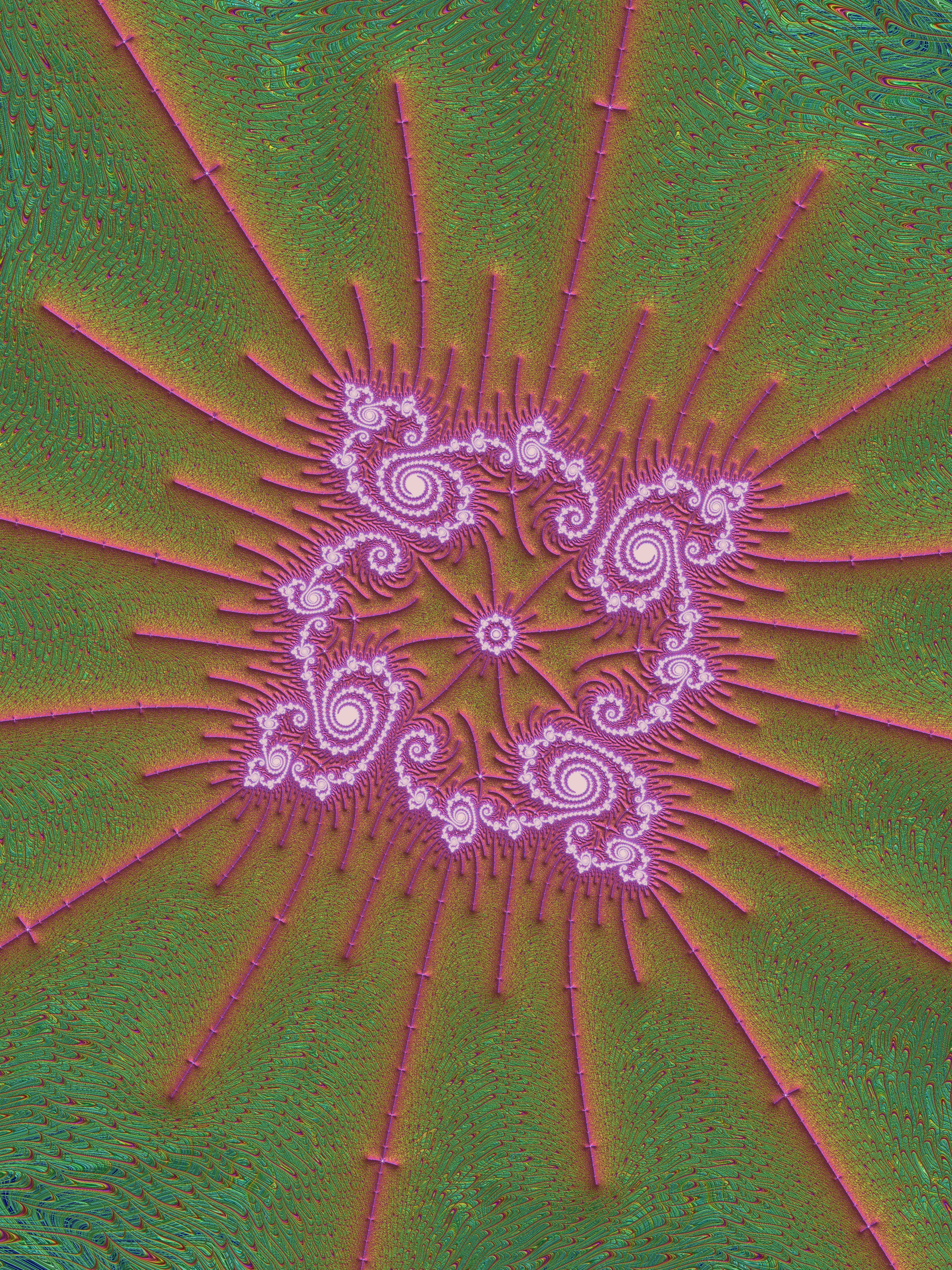
The image is a 2D projection of a conceptual 3D torus, or perhaps a complex radial structure. Its primary visual characteristics are defined by a sense of motion, transition, and radial symmetry.
This is an amazing 60 Mega Pixel fractal image created with Fragmentarium, which uses the computer video card (GPU) to instantaneously render these images. This means that you can fly through the fractal space in real time and make adjustments to color and rendering detail immediately. Quite a change from the days when an image like this would have taken minutes (or even hours) to appear on the screen.
Fragmentarium can be downloaded from: syntopia.github.com/Fragmentarium/index.htm